At a Glance
- Portugal has had a remarkable year across four of the more credible 2026 quality-of-life and city rankings: Resonance, Time Out, the Institute for Quality of Life’s Happy City Index, and Numbeo’s quality-of-life data.
- Lisbon ranked 13th in Europe in the Resonance Best Cities 2026 ranking. Porto came in at 38th. They were the only two Portuguese cities to make the European top tier on that index.
- Porto placed 17th globally in Time Out’s 2026 Best Cities in the World, drawn from a survey of more than 24,000 residents across 150 cities, with high marks for value, food, and what Time Out calls “big-city buzz.”
- The Happy City Index 2026 placed eight Portuguese cities in its global top 250, with Maia leading at 69th worldwide. Numbeo’s 2026 quality-of-life data places Porto at 104th globally, ahead of Lisbon at 176th, making Porto the strongest Portuguese city on that measure.
- Portugal also sat 7th on the 2025 Global Peace Index, placing it among the ten most peaceful countries on earth, a factor that increasingly shapes how internationally mobile families weigh European destinations.
It has been a remarkable year for Portugal in the international rankings, and the picture they paint together is more interesting than any single headline. Across four of 2026’s most credible quality-of-life and city indices, Portuguese cities have featured prominently and consistently, and not always the ones a casual reader might expect. For internationally mobile families and retirees considering Portugal as a European base, the cumulative pattern is worth pausing over.
What the various 2026 rankings have in common is methodology that reaches beyond cost-of-living averages and sunshine hours. They look at governance, mobility, healthcare, safety, the environment, and how residents themselves feel about their cities. When a country of just over ten million people repeatedly places multiple cities inside global top tiers across that kind of methodology, the result tells us something real about the lived experience on offer.
Portugal Across the 2026 Rankings
Each of the four rankings worth highlighting brings a different lens, which is what makes Portugal’s strong showing across all of them so meaningful.
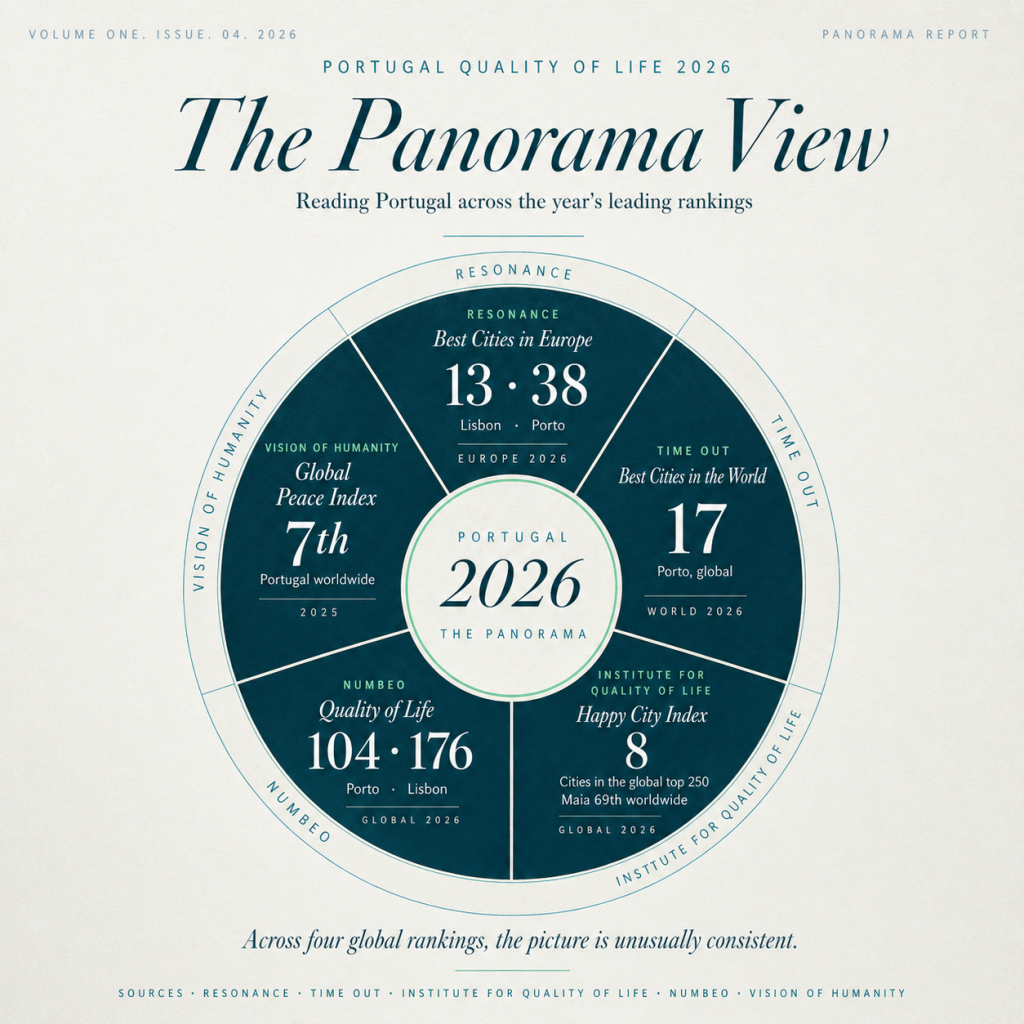
Resonance Best Cities in Europe 2026 ranks Lisbon 13th in Europe and Porto 38th. Resonance weights factors used by relocators and high-end travellers, including coastal access, nightlife, food, and cultural depth. Lisbon and Porto were the only Portuguese cities to make the European top tier on this measure, an unusually strong result for a country of Portugal’s size.
Time Out Best Cities in the World 2026 placed Porto 17th globally, drawn from a survey of more than 24,000 residents across 150 cities and supplemented by a panel of more than 100 city experts. Porto rated particularly strongly on value, food, and what residents themselves describe as the lived feel of the city.
Happy City Index 2026, published by the Institute for Quality of Life, evaluated 251 cities across 64 indicators and six dimensions: Citizens, Governance, Environment, Economy, Health, and Mobility. Eight Portuguese cities appeared in the global top 250, with Maia at 69th, Matosinhos at 111th, Odivelas at 114th, Almada at 124th, Lisbon at 159th, Braga at 166th, Gondomar at 199th, and Funchal at 225th.
Numbeo’s 2026 quality-of-life data places Porto at 104th globally, ahead of Lisbon at 176th, making Porto the strongest Portuguese city on a composite score that weights safety, cost of living, healthcare access, and environmental factors.
The point of putting these side by side is not to crown a single ranking but to read across them. Each has its own bias. Resonance is built around relocator-relevant lifestyle factors. Time Out captures resident sentiment. The Happy City Index leans heavily on governance and infrastructure. Numbeo aggregates user-submitted data on practical conditions. Portugal placing strongly across all four says something the individual rankings cannot: the underlying lived reality is consistent, and that consistency is what families considering a long-term move should care about.
What the Pattern Actually Means
The 2026 rankings tell two stories that matter for the kind of decision our clients are weighing.
The first is that Lisbon and Porto have separated from the rest of Southern Europe as the twin pillars of Portugal’s lifestyle proposition, and each plays a different role.
Lisbon is the European capital and the natural entry point for most internationally mobile families. Its 13th-place finish on Resonance reflects what the city actually delivers in lived experience: the light, the river, the food, the openness of public space, and the ease with which a sophisticated international life can be assembled there. It sits 159th on the Happy City Index because housing cost pressure weighs more heavily on that methodology, but the cities ahead of Lisbon on that list are mostly Northern European capitals with very different climates and cost bases.
Porto’s profile is different and increasingly compelling. Its 17th-place global finish in Time Out, paired with a higher Numbeo quality-of-life position than Lisbon, points to a city rising fast in the consideration set of relocating families. The cost base sits meaningfully below Lisbon’s, the cultural depth has gathered remarkable momentum, and the practical quality of life has now been confirmed across two distinct methodologies.
The second story is the depth beyond the two main cities. Maia at 69th, Matosinhos at 111th, Odivelas at 114th, and Almada at 124th are not cities most international readers would have considered, but their presence in the global top 250 reflects something real about how Portuguese urban life is structured. Many of these are metropolitan-area satellites with strong infrastructure, low crime, accessible healthcare, and a generosity of public space that holds up against far better-known European peers.
Safety and Stability: A Genuine Differentiator
Portugal sat 7th on the 2025 Global Peace Index, placing it firmly among the ten most peaceful countries on earth.
For families relocating from higher-risk environments, that ranking is anything but abstract. It shows up in the small things: walking home after dinner without a second thought, watching children come and go from school by themselves, moving through a city without security overhead. Families who have lived without that quality recognise immediately what it is worth, and they tend to weigh it heavily when choosing where to set down roots.
The contrast has become more relevant for North American families in particular. Interest from US-based individuals and families in Portuguese residency options has grown sharply, with leading advisory firms reporting a 60 to 67 percent increase in American applications and inquiries between 2024 and 2025. Portugal’s combination of political stability, low crime, and a functioning, predictable legal system inside the European Union is a meaningful part of the appeal. It is rarely the only reason families look at Portugal, but it is consistently one of the first reasons they give.
What Lisbon Actually Delivers
The headline numbers matter, but the everyday experience matters more. Four areas tend to drive the decision for the families we work with.
Private healthcare that holds up under scrutiny
Lisbon’s private healthcare network is modern, well-staffed, and widely used by the international community. CUF and Hospital da Luz operate English-speaking facilities with appointment availability that is considerably faster than most Western European public systems. Private health insurance for working-age adults typically runs between €100 and €150 per month for mid-range coverage, with premiums rising for older age brackets and broader plans. For retirees in particular, the quality and accessibility of private healthcare at that price point is one of the most quietly compelling parts of life in Portugal.
A climate that supports outdoor living year-round
Lisbon averages roughly 280 to 300 days of sunshine per year and around 2,800 hours of annual sunlight. The city is compact enough to navigate on foot but substantial enough to sustain a full professional and cultural life, and it is one of the few European capitals where being outdoors is a year-round habit rather than a seasonal indulgence. For families used to harsher winters, that alone reshapes the rhythm of daily life.
International connectivity at scale
Lisbon’s airport connects to 152 non-stop destinations across 52 countries. For families maintaining a European base while keeping the rest of their lives operational elsewhere, that range of direct connections is a real practical advantage. Direct routes to major North American cities, including New York, Boston, Miami, Los Angeles, and San Francisco, make Portugal genuinely accessible from the United States in a way several European alternatives are not.
A growing international community with depth
Lisbon’s international community has grown substantially and matured beyond the early-wave expat profile. In 2022, foreign nationals accounted for 12 percent of the metropolitan area’s residents, a figure that has continued to grow. The community now includes a meaningful concentration of professionals in financial services, technology, and private wealth, which gives families settling there both social warmth and professional relevance, rather than the more transient feel of a short-term posting.
The Porto Story
Porto’s strong showing across the 2026 rankings reflects a city that has come into its own. The cost base sits noticeably below Lisbon’s, the food and arts scene has gathered serious depth, and the international community has grown without diluting the city’s distinct Portuguese character.
For families who want a city that feels unmistakably Portuguese while offering a softer cost base than the capital, Porto deserves serious consideration. The airport offers strong European connectivity, Portugal’s main motorway and rail axis runs through the city, and the surrounding region of northern Portugal offers some of the country’s most rewarding food, wine, and natural landscape. Time Out’s 17th-place global ranking is a meaningful endorsement, particularly when the methodology rests on the voices of more than 24,000 residents around the world.
International Schooling: What Families Need to Know
For families with children, schooling is often the deciding factor, and Portugal handles this well. Lisbon and the Greater Lisbon Area, which includes Cascais, Estoril, and Sintra, host 36 international schools offering a wide range of curricula, including British, American, International Baccalaureate, French, German, and hybrid Portuguese-international programmes. Porto has a smaller but credible international schooling ecosystem, including the Oporto British School and CLIP, which serves families on a similar basis.
Annual tuition for the 2025/2026 academic year generally runs between €9,000 and €23,000, depending on the school, the year group, and the curriculum. Notable Lisbon options include the Carlucci American International School of Lisbon, with fees from approximately €11,716 to €22,736; the British School of Lisbon, with fees from €13,110 to €21,375; and St. Julian’s School at the higher end of the local market.
For families from North America, finding a well-regarded American-curriculum school inside a major European city is a genuine practical advantage. Lisbon offers it, and the fees, while substantial, sit comfortably below equivalent international schooling in cities like London, Geneva, or Zurich.
Food, Culture, and Atmosphere
Portuguese food has had its own quiet revolution, and 2026 is a strong year to notice it. The Michelin Guide recognises 53 starred restaurants nationally, with Lisbon home to 16 of them, including three at two stars: Alma, Belcanto, and Fifty Seconds, the latter promoted in the 2026 guide. The city’s dining culture spans refined tasting menus and excellent neighbourhood restaurants where the food is serious without the formality.
The cultural infrastructure is equally substantial. The Belém Cultural Centre runs a year-round programme of exhibitions, performances, and international events. Fado, the city’s defining musical tradition, remains alive in neighbourhood houses in Alfama and Mouraria, and is worth experiencing as something genuinely local rather than as a curated tourist arrangement.
For those who want an active social life after dark, Lisbon delivers. Bairro Alto is dense with small bars that fill up late and stay lively into the early hours. Cais do Sodré and the Pink Street area carry a more club-focused energy. For affluent expats who prefer something quieter, the riverside districts of Santos and Lapa have developed a reputation for serious restaurants, wine bars, and a sociable international crowd without the noise of the main nightlife corridors.
Beyond the Two Big Cities
Lisbon and Porto are the obvious entry points, but Portugal’s geography offers real variety, and different areas suit different priorities.
Cascais sits 30 minutes west of Lisbon by train, with a marina, golf courses, beach access, and a well-established international community. It combines coastal living with easy access to the capital, and is particularly popular with families who want space and a quieter pace without giving up proximity to Lisbon’s infrastructure.
The Algarve appeals strongly to retirees and families looking for warmth, outdoor space, and a slower rhythm. The Golden Triangle, covering Vilamoura, Vale do Lobo, and Quinta do Lago, offers high-end amenities, world-class golf, and one of the most established expat networks in Southern Europe. English-speaking services are widely available, which makes the practical side of relocation a great deal easier.
The Silver Coast, a 240-kilometre stretch of Atlantic coastline north of Lisbon, is gaining attention from families who want space, nature, and relative affordability. It is less developed than the Algarve, which for some is precisely the appeal. Towns like Óbidos, Nazaré, and Caldas da Rainha offer strong quality of life at a cost level that makes the Algarve look expensive by comparison.
The Honest Trade-Off
No serious assessment of Lisbon would be complete without acknowledging that housing costs have risen sharply. A two-bedroom apartment in a sought-after area such as Príncipe Real, Chiado, or Belém will typically run from around €1,850 per month on the rental market, with three-bedroom family properties running considerably higher in prime districts. Porto’s prime market has tightened in recent years too, though it remains noticeably below Lisbon.
For a family office or UHNW individual, those figures are unlikely to be the determining factor, but they are worth saying clearly. Even at today’s elevated levels, Portugal’s cost base remains meaningfully better value than comparable lifestyle access in London, Paris, Geneva, or Zurich. A well-structured Portuguese life, covering private healthcare, quality schooling, premium housing, and regular travel, can be maintained at a monthly budget that would not come close to covering equivalent quality in those cities.
Why This Matters for Residency Planning
For a family using Portugal’s Golden Visa to build a European residency framework, the lifestyle case does not sit separately from the planning case. It is part of it.
The Golden Visa’s minimum stay requirement, 7 days in the first year and 14 days in subsequent two-year periods, is low enough that many families hold the residency without spending much time in the country. That works for some. But the families who get the most from a Portuguese residency over time are those for whom Portugal also makes genuine sense as a place to spend time, where the schools, the healthcare, the food, the climate, and the everyday environment all hold up under closer inspection.
The 2026 rankings, taken together, point in the same direction. Across four different methodologies, Portuguese cities have shown a consistency that is rare in this kind of data. For the kind of family Portugal Panorama works with, that consistency is the part worth paying attention to.
Frequently Asked Questions
How does Portugal compare on the 2026 quality-of-life rankings? Portugal placed strongly across four major 2026 rankings: Resonance (Lisbon 13th, Porto 38th in Europe), Time Out (Porto 17th globally), the Happy City Index (8 cities in the global top 250, Maia at 69th), and Numbeo (Porto 104th and Lisbon 176th globally, making Porto the strongest Portuguese city on that measure). Portugal also sat 7th on the 2025 Global Peace Index.
Which is better for HNW families, Lisbon or Porto? Both are credible, and the right answer depends on the family. Lisbon offers the deeper international community, more international schools, broader flight connectivity, and the structural advantages of a European capital. Porto offers a lower cost base, strong cultural identity, and the highest 2026 resident-voted ranking of any Portuguese city in Time Out’s global list. Many families settle on one based on schooling and connectivity priorities.
Is Portugal a good destination for American retirees? Portugal is consistently among the most popular European destinations for North American retirees. The 2025 Global Peace Index ranking, the price and accessibility of private healthcare, and direct flight connections to major US cities including New York, Miami, Boston, and Los Angeles support that. Leading advisory firms reported a 60 to 67 percent increase in American applications and inquiries between 2024 and 2025.
What international schools are available in Portugal? Lisbon and the Greater Lisbon Area host 36 international schools across British, American, IB, French, German, and hybrid curricula. Porto has a smaller but credible network, including the Oporto British School and CLIP. Annual tuition for 2025/2026 typically runs between €9,000 and €23,000 depending on the school and year group.
What is the cost of living in Portugal for wealthy expats in 2026? A premium Portuguese lifestyle covering private healthcare, quality schooling, high-end housing, and regular travel can be maintained well below equivalent costs in London, Paris, or Zurich. Prime Lisbon two-bedroom rentals typically run from around €1,850 per month, with Porto’s prime market sitting noticeably below that.
What are the best areas in Portugal beyond Lisbon and Porto? Cascais offers coastal living 30 minutes from Lisbon. The Algarve’s Golden Triangle provides warm weather, golf, and a well-established international community. The Silver Coast appeals to those wanting space, nature, and affordability. Each suits different lifestyle priorities.
At Portugal Panorama, our work begins where the rankings end, with the question of whether Portugal would actually fit your family. Lisbon and Porto each offer something different, the regions outside the two big cities have their own logic, and the residency planning piece runs across all of it. If you are at the stage of weighing Portugal seriously against other European bases, we would welcome the conversation.